Randori vs Shiai: How Hard Should You Go in Judo?
Should you fight every throw in practice? How hard is too hard with a beginner, a smaller teammate, or your sensei? A practical guide to randori, competition, and being someone people want to train with.
You bow to a teammate, take a grip, and start moving. A minute later, neither of you has attempted a throw. You are both working hard, but mostly at making sure the other person cannot do any judo.
Or perhaps the opposite happens. A senior belt gives you room to attack, you get a throw, and then spend the water break wondering whether it counted.
These moments raise a question that is surprisingly hard to answer when you are new: how hard are you supposed to go in randori?
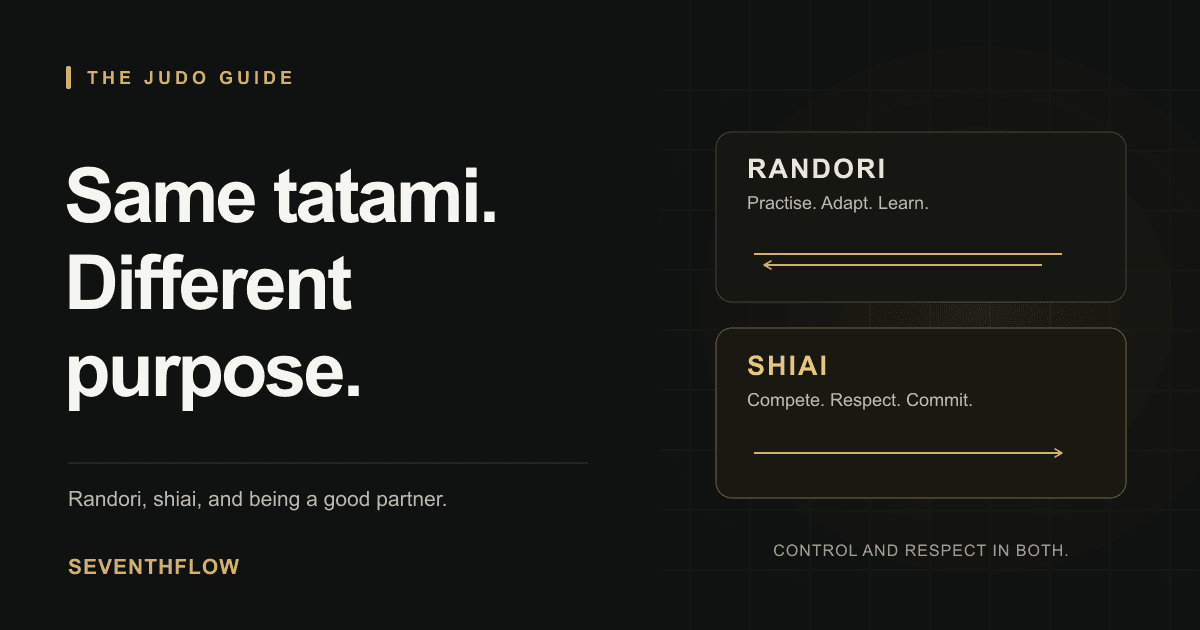
The short answer is to match the purpose of the round and the person in front of you. A tournament contest, a hard round before a competition, and a beginner's first attempt at moving randori have different jobs. They all require control and respect.
Randori vs shiai: practice and competition have different jobs
Randori is free practice; shiai is a contest. The IJF uses those terms to distinguish the two. What people sometimes call “competition randori” could mean a formal match, or it could mean competition-style practice at the dojo. Ask which one they mean. IJF: randori and shiai terminology.
In shiai, you are trying to win under the rules of that event. Attacking, defending, countering, and making tactical decisions all serve that result. You do not have to provide your opponent with an easy opening because they have been struggling to throw you.
In randori, the round is there to develop something. It might be your timing, your willingness to attack, your response to a particular grip, or your ability to stay effective under competition pressure. British Judo describes a range from low-resistance practice for newer students to hard randori approaching contest demands. British Judo: levels of randori.
| Setting | Main purpose | What to agree or check |
|---|---|---|
| Developmental randori | Explore attacks and responses with a partner. | The task, resistance, pace, and any technique restrictions. |
| Competition-preparation randori | Test decisions and execution against demanding opposition. | Coach-approved partners, intensity, and whether scoring or tactical scenarios apply. |
| Shiai | Win the contest fairly. | The event's eligibility, divisions, permitted techniques, and referee instructions. |
A hard training round can be excellent practice. The problem starts when one person thinks they are exploring a new attack and the other thinks they are defending an Olympic final.
Is it okay to go all out in randori?
Sometimes a coach will want a demanding round between suitable, prepared partners. Sometimes that would spoil the lesson. Being the same weight and belt does not settle the question.
USA Judo's coaching guidance makes room for different training intensities rather than turning every session into maximum-effort randori. USA Judo: New Paradigm for the Modern Judoka. That is a useful starting point for the conversation, rather than a universal percentage to copy.
“Light” is easy to misunderstand. One person means moving freely and giving opportunities. Another means gripping as hard as possible but finishing the throw gently. Describe the behavior you want: “Can we keep moving and give each other chances to attack?” or “Are we doing a scored round with counters?”
A good round still has effort. You should pay attention, move with intention, and try to solve the problem. You can work hard at those things without making every exchange a test of who can overpower whom.
Should you let someone throw you in randori?
This is where a well-meant instruction can become confusing. “Let the throw happen” might describe several quite different choices.
Giving an opportunity: in an agreed developmental round, you leave a usable opening instead of closing down every attack. Your partner still has to recognize it and do something with it.
Reducing resistance: you use the level of opposition the exercise calls for. That may let a partner work on timing before they are ready to solve the same problem against your strongest defense.
Receiving a throw: an attack has caught you, and you use the ukemi your instructor has taught rather than making a desperate effort to stay upright. Learn that judgment in person. This article cannot tell you when a particular landing or escape is safe.
Accepting a throw does not mean suddenly releasing grips or dropping your partner. Keep the control your instructor has taught you.
Manufacturing a result: you jump, collapse, or throw yourself despite an attack that has not worked. Unless your coach has specifically assigned an assisted exercise, that gives your partner misleading feedback.
So, yes: in the right round, allowing a well-timed attack to develop can be useful. There is no universal rule that every decent entry earns a free throw. There is also no training prize for turning every promising attack into a dangerous struggle.
If you are unsure, ask your sensei to watch an exchange: “Was I giving useful resistance there, or shutting the exercise down?” For the differences between receiving a technique in drills and exchanging attacks in randori, read our guide to being a good uke in Judo.
How to adapt to the person in front of you
Size, rank, age, and experience all give you information. None tells you the whole story. USA Judo's planning checklist explicitly asks instructors to consider differences in size, height, and sex, as well as how students are grouped and whether the learning level is appropriate. USA Judo: planning for instruction.
The following are practical conversation examples, not a separate set of official contest rules. Use your instructor's assessment of the pairing and the task.
With a beginner or lower belt
Give them a problem they have some chance of understanding. If every attempted grip gets stripped and every tentative attack gets countered, they may spend the round trying to survive rather than learning to attack.
You could ask the coach for a restricted round: perhaps a particular grip, a limited set of attacks, or a clear role for each partner. Have the instructor set it up so you both understand what you are working on.
A lower belt may bring years of wrestling or another grappling art. Equally, a physically strong beginner may still have very limited falling skills. Check what they can actually do instead of treating the belt as the whole assessment.
With someone smaller, lighter, or much shorter
Notice what your size allows you to get away with. If you can stop every exchange just by holding someone at a distance or leaning your weight on them, consider whether that serves the agreed task.
You can work on movement, timing, and a specific technical problem while adjusting the pressure you apply. In the IJF's publication of Kano's writing, he argues against relying on a physical advantage alone in randori. IJF: Judo, What Is It All About?
Height changes reach and the feel of grips; it does not, by itself, tell you someone's skill or preferred pace. If the mismatch makes the exchange difficult to control, ask the coach to change the task or pairing.
With someone of a different gender
Use the same checks: actual size, strength, experience, readiness, and the round you have agreed to do. Gender alone cannot tell you whether someone wants a technical exchange or a demanding competition-preparation round.
Do not make a show of taking it easy or assume that a woman needs you to give her throws. Do not turn the round into a strength demonstration either. Ask a normal training question, listen to the answer, and adjust to the person.
With a teammate your own size and level
This can be a good pairing for hard practice if that is today's plan. It is also a good pairing for learning something neither of you does well yet.
A familiar teammate still deserves an agreement. They might be tired, returning after time away, or working on an unfamiliar attack. “We usually have a hard round” is worth checking again before the first grip.
With your sensei or a senior black belt
Ask what they want you to work on. They may be giving you a particular opening, studying your reactions, or simply taking a normal round. A teaching round is easier to use when you understand the task.
Make sincere attempts within that task. If you throw them, there is no need for either a victory speech or an investigation into whether they allowed it. Ask what made the opportunity possible. The IJF's discussion of the sensei emphasizes adapting teaching methods to the learner while respecting safety. IJF: Sensei, the Key Figure.
A high rank is not a promise of unlimited fitness or tolerance for force. Age, fatigue, and current limitations still matter.
With someone who asks to slow down
Slow down. If the proposed adjustment does not work for either of you, pause and ask the coach for another exercise or partner. Neither person needs to win an argument about whether the original pace was reasonable.
You can decline a round, including with a senior person. If an agreed limit keeps being ignored, stop and involve the instructor. Respect should make it easier to speak up.
Are counters bad etiquette in practice?
No blanket ban makes sense for every round. Defending and countering are part of Judo, and a coach may specifically want you to practise them. The question is whether that response fits this exchange.
Consider two examples. In one, prepared partners are working on attacks and counters under the coach's supervision. In the other, a beginner has been asked to build confidence committing to an attack, and a much more experienced teammate counters every attempt. The same broad category of technique can serve very different purposes.
Agree whether counters are included and what restrictions apply. Do not introduce an unfamiliar or high-impact response just to settle an exchange after being thrown. If either of you feels the pace rising out of frustration, pause instead of answering with a harder throw.
What changes in competition, and what etiquette remains?
In shiai, you can fully commit to winning within the event's rules. A legal, controlled counter can be the right decision. Your opponent is trying to stop your Judo, just as you are trying to stop theirs.
That commitment still includes respect for the opponent, officials, and rules. The IJF's discussion of competition at the 2026 world championships makes that connection explicitly, including the bow before and after a contest. IJF: Beyond the Medal.
Follow the referee's commands, release immediately when a partner submits or the referee directs you to stop, and avoid retaliatory or prohibited actions. Have your coach explain the rules that apply to your age group and event, including which groundwork techniques are permitted. IJF's current competition regulations are a reference for IJF events; a local novice competition may use adaptations.
One other correction: a contest does not guarantee an opponent with your exact belt or experience. Some events use grade bands; some accept different eligible ranks within a division. As one local example, British Judo's published Shinsei event outline groups certain kyu grades together and allows some weight categories to be combined. Read your own event outline. Shinsei 2026 competition divisions.
“I am here to win” is a sporting objective. Keep it connected to the rules and the judgment you have practised with your coach.
A ten-second conversation before you take a grip
You do not need a formal negotiation with every teammate. One clear question often does the job. Try:
- “Are we keeping this technical, or preparing for competition?”
- “Can we focus on moving and attacking rather than blocking everything?”
- “Are counters part of this round?”
- “I'm new to this. Can we check with sensei what I should be doing?”
Then do what you agreed. Bow, stay aware of the space and other pairs, and thank your partner when you finish. A brief agreement is only useful if you keep it once the round becomes interesting.
Remember the lesson, not an imaginary practice score
After class, “I got thrown three times” tells you very little on its own. Were you trying a new attack? Working with a much more experienced partner? Keeping a technical round open so both of you could move?
A more useful note might look like this:
Four randori rounds. The first two were technical; the last two were harder rounds agreed with my partner.
Coach's feedback: I stop moving after my first attack.
Next class: ask for another round focused on continuing the attack.
SeventhFlow lets you record Judo training and randori rounds, with notes for the details a number cannot explain. Keep the purpose and perceived intensity in your own session note; those details do not have to become a win-loss record.
Your practice also happens inside a community. Add Judo and your dojo to your profile, follow teammates, and stay connected to coaches and the people you train with. When you share something from class, make it a useful lesson or a moment worth remembering, and get permission before posting someone else's image.
Start with the next session while it is fresh. A sentence about what changed can be more useful a month later than trying to remember who threw whom.
Your Judo community
Keep the lesson from your next round.
Log your Judo practice and randori in SeventhFlow, add a note about what you worked on, and stay connected to the dojo and people helping you improve.
Judo randori etiquette: frequently asked questions
What is the difference between randori and shiai?
Randori is free practice. Shiai is a contest decided under the event's rules. Randori can be light, technical, or very demanding, but its intensity and constraints should serve the training task. A competition-style round in your dojo is still practice.
Should you let people throw you in randori?
In a light or developmental round, you may agree to leave openings and offer less resistance. That is different from jumping for an ineffective attack. When a throw has caught you, use the ukemi your instructor has taught rather than risking injury to avoid falling. In more competitive rounds, appropriate defense and counters may be part of the task.
Is it rude to counter in randori?
A counter is not automatically rude. It depends on the agreed exercise, your partner's experience, and whether you can perform it with control. A beginner's technical round and a competition-preparation round may call for different responses. Ask your coach whether counters are part of the round.
How hard should you go with a lower belt or smaller partner?
Agree on the task and pace, and ask the instructor to check that the pairing is suitable. Adjust for actual experience, size, strength, falling skills, and readiness. Avoid using a physical advantage to shut down every exchange. A smaller partner may still be highly experienced, and a lower belt may have other grappling experience.
Do people in a judo competition always have the same belt?
No. Events use different eligibility and grouping systems. Some have grade bands, while others bring together eligible athletes of different ranks in a weight and age category. Categories may also be combined at some local events. Read the event outline and confirm your division with your coach.
Sources and editorial approach
Reviewed October 18, 2026. This guide combines federation definitions and coaching guidance with SeventhFlow's practical examples and conversation prompts. Clubs use different training methods; the examples are not a universal randori rulebook. Learn physical techniques, defensive decisions, and ukemi with a qualified instructor.
- IJF: Army and Police at the Judo Pace, for the randori and shiai distinction.
- British Judo: What Will I Learn from Judo?, for the range of randori intensities.
- USA Judo: New Paradigm for the Modern Judoka and Planning for Instruction (2010 coaching articles), for varied training demands and adapting instruction to different participants.
- IJF: Judo, What Is It All About?, for Kano's discussion of physical advantages in randori. A historical text, not a current list of permitted techniques.
- IJF: Sensei, the Key Figure, for the instructor's teaching responsibilities.
- IJF: Beyond the Medal (2026), for respect and conduct in competition.
- British Judo: Shinsei competition outline (2026), as a specific example of event groupings, and IJF competition regulations for the current official reference.