How to Be a Good Uke in Judo: A Training Partner’s Guide
Uke receives the technique, but the role takes attention, skill, and trust. Learn what your partner needs from you in drills and randori—and what you should expect in return.
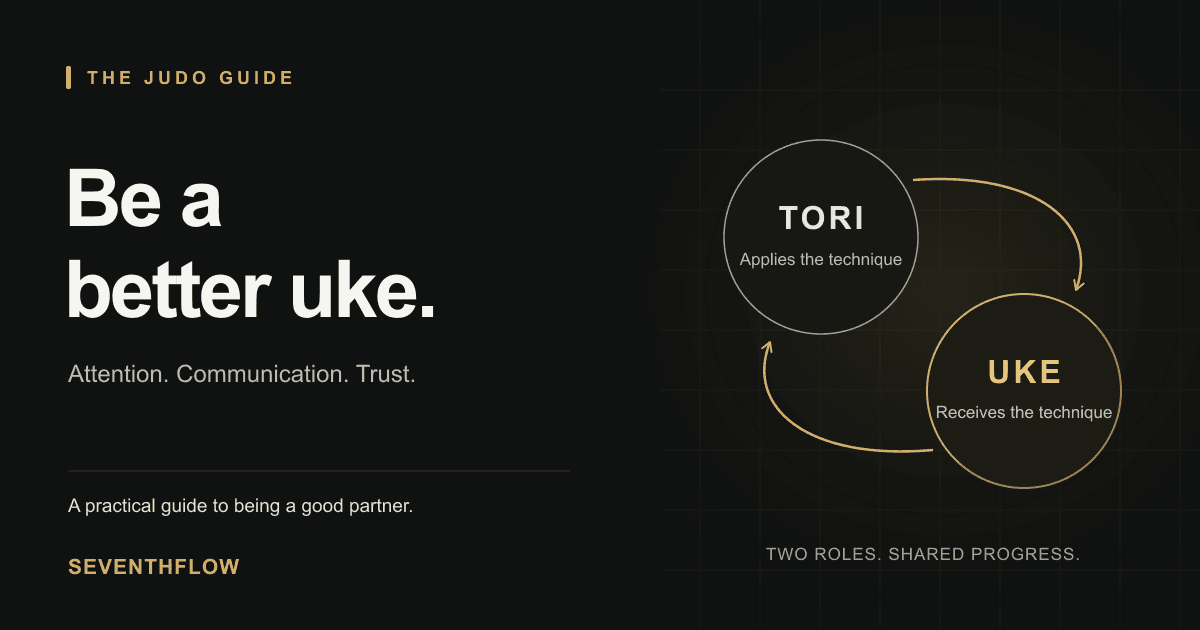
In judo, uke is the person receiving a technique; tori is the person applying it. During a throwing drill, tori performs the throw and uke receives it, using the falling skills they have learned. You will usually practise both roles.
Being a good uke takes attention, communication, and practice. You help your partner learn while developing your own movement and falling skills. You should also be able to speak up, slow down, and ask for help. Both partners share responsibility for the exercise.
This guide is for beginners and returning judoka who want to contribute more confidently in class. Use it to prepare questions for your coach. Learn throws and breakfalls in person, on suitable mats, under qualified instruction.
What is uke in judo? Uke vs tori vs ukemi
These three words describe different parts of the same practice:
- Uke: the partner who receives the technique being studied.
- Tori: the partner who applies that technique.
- Ukemi: receiving a fall or breakfalling—the skill uke uses when being thrown.
Judo Canada's syllabus makes this distinction when explaining how its technical progression accounts for both partners' safety, particularly uke's ability to receive a fall. Judo Canada, national kyu syllabus, p. 5.
Imagine your coach assigns a throwing exercise. While your partner practises the throw, you are uke. When you switch, you become tori. The labels describe the current task; they do not establish a hierarchy between you.
The role also extends beyond standing throws. You can be uke for groundwork or a kata, a prescribed sequence of techniques. “Receiver” is more useful than assuming uke always waits passively: in kata, uke may initiate an attack and must supply the appropriate action and response. The IJF describes this as a precise contribution to a shared movement. IJF: Where Two Partners Make One Movement.
How to be a good uke: six skills to develop
Use the following as a practical discussion framework with your instructor. The right response depends on the technique, your experience, and the purpose of the exercise.
1. Treat ukemi as something you are learning every class
Give the falling practice your full attention. Ask your coach which falls you can receive comfortably and which need more work before you take the corresponding throws. British Judo's introductory syllabus already includes backward, sideways, and forward rolling breakfalls: this is foundational material. British Judo novice syllabus.
Tell the instructor if you do not understand the landing for a particular throw. A familiar name or a higher belt on your partner does not tell them what you are ready to receive today.
A safety point to discuss in person: do not try to stop a backward fall by bracing on your hands or elbows. The IJF's safety explanation identifies that response as dangerous. Ask your coach to teach and check the appropriate ukemi; a written cue cannot assess your landing. IJF explanation of landing safety.
2. Understand the job before the repetition starts
Ask whether you are practising an entry, completing a throw, working on a response, or doing a live exchange. Agree on the direction, pace, and role your coach wants you to provide.
For example: “Are we doing entries only, or finishing the throw?” That is a useful question even if everyone else seems to understand. It resolves a practical uncertainty before either partner commits to the movement.
3. Give the movement the drill calls for
Listen for instructions about posture, grips, steps, and resistance. Keep those conditions consistent enough for your partner to work on the assigned problem. If your coach asks for movement, participate in that movement; if the task changes, make sure you both understand the change.
Avoid adding an unrequested jump or collapsing early to make the throw appear successful. Equally, do not surprise a partner in a cooperative drill with a block or counter. If a repetition stalls, reset and ask the coach what each of you should change. This is our practical way of applying the distinction between cooperative and resisting exercises, rather than a rule that uke must always move the same way.
4. Stay attentive through the reset
The next repetition deserves a fresh check. Is your partner ready? Is there room? Have you drifted toward another pair? Did the instructor stop the group? Pause when the space or instructions are unclear.
Make switching roles explicit when needed. “One more, then your turn?” is easier to work with than leaving a partner uncertain about when to move or who is throwing next. Follow the rotation your coach sets, including any adaptations for either partner.
5. Give useful feedback without trying to become the instructor
Describe your own experience accurately. Useful examples include “I wasn't ready for that repetition,” “I don't understand which step you need,” and “Can we ask the coach to watch us?” These give your partner something concrete to respond to.
When you are unsure about a technical correction, bring the question to the instructor. The IJF's discussion of the sensei emphasizes choosing teaching methods appropriate to the learner and protecting participants' safety. That is a good reason to keep your coach involved when the exercise is not working. IJF: Sensei, the Key Figure.
6. Be clear about your limits and respect your partner's
You can say that you need a slower pace, a pause, or a different exercise. Your partner can say the same. Neither person needs to prove commitment by continuing through pain or accepting a repetition they do not understand.
Tell your coach about an injury or limitation that affects practice. You do not have to explain private medical details to the whole class. Agree on what is suitable before continuing, and respect a partner's request to stop without bargaining for another throw.
Uke in uchikomi, nagekomi, randori, and kata
The IJF Academy distinguishes repeated entries, repeated throws, and fighting exercises with different tasks and intensities. That distinction matters more than a blanket instruction to “always resist” or “never resist.” IJF Academy student handbook: technique training.
| Practice | Your task as a partner |
|---|---|
| Uchikomi | Repeated entries into a technique, usually without completing the throw. Provide the agreed stance or movement and reset with your partner. Confirm whether a finishing throw is part of the drill. |
| Nagekomi | Repeated throwing practice. Be ready for the agreed throw, use the ukemi you have been taught, and check readiness and space between repetitions. |
| Randori | Free practice with the constraints your coach sets. Both people can attack and defend; you do not remain a designated receiver throughout the round. Keep the agreed intensity and respect stop signals. |
| Kata | A prescribed sequence in which uke's timing, attacks, and responses are part of the technique. Learn your own role as carefully as your partner learns theirs. |
A question worth making habitual: “What response do you want from me in this exercise?” If you and your partner give different answers, ask the instructor before continuing.
For how to adjust a live round to your partner's size and experience, read randori vs shiai: intensity and etiquette in practice and competition. It covers counters, allowing throws to develop, and agreeing on the purpose of a round.
What if you are nervous, tired, or not ready?
Explain what is happening as specifically as you can. Perhaps the throw is unfamiliar, the pace is too fast, you are losing concentration, or you are worried about a previous injury. Your coach can do more with that information than with a quiet attempt to endure the exercise.
Ask for a check of your falling skills and an appropriate progression. Judo Canada's learning guidelines distinguish a beginner acquiring a movement from a skilled judoka practising under demanding conditions. They emphasize a clear task, a sense of safety, and suitable practice conditions early in learning. Judo Canada learning guidelines, pp. 6–7.
Useful ways to start the conversation:
- “I haven't received this throw before. Can you show me my part?”
- “That pace is beyond what I can manage today. Can we adjust it?”
- “I'm too tired to concentrate on the landing. I need a break.”
- “I'm not comfortable continuing with this exercise. Can you help us find an alternative?”
Stop the exercise if you are in pain or the agreed limits are being ignored, and involve the coach. A request to pause should be respected. You can decline a drill or partner; being useful to someone else's training does not require accepting an unsafe situation.
What should you expect from tori?
Your partner should know what you have agreed to practise, work at the appropriate level, and take responsibility for control when applying the technique. If you are unsure about receiving it, tori should help involve the instructor before another attempt.
Uke's falling skills do not remove tori's responsibilities. Both people should listen, notice when something has changed, and respect a stop signal. In groundwork, honor a tap or verbal stop immediately and follow your coach's age-appropriate rules.
Experienced judoka still take both roles. In its report Both Tori, Both Uke, the IJF describes elite athletes and coaches sharing the throwing and receiving work during warm-ups. Receiving techniques remains part of a training partnership as experience grows.
A good uke checklist for your next class
Use this short check before a set of repetitions. It is our class-preparation aid, not a substitute for your instructor's directions.
- Task: I know whether we are doing entries, throws, or a resisting exercise.
- Readiness: My partner and coach know if I am unsure about receiving this technique.
- Agreement: We understand the pace, movement, and resistance requested.
- Space: We have checked the area and are paying attention to other pairs.
- Communication: Either person can pause; we will ask the coach when we need help.
- Learning: I have one question or observation to take away from this practice.
After class, choose one small improvement to remember: you asked for clarification earlier, understood your role in a drill, or received a particular throw more confidently under supervision. Those are useful observations even when the session brought no new belt or competition result.
For how those foundations fit into formal progression, read our Judo belt requirements guide, covering skills, training time, and competition expectations.
Make your training history part of your Judo profile
Your training partners and coaches are part of your progress. SeventhFlow gives your martial arts profile a place alongside your sessions, dojo, coaching relationships, and community.
Start with a brief session note. Here is an example you can adapt:
Today’s focus: understanding my role in throwing practice.
Coach’s feedback: ask for the direction and pace before we start.
Next class: have the coach check my ukemi for the throw we are learning.
Download SeventhFlow for iOS and create your account. Add Judo to your profile, choose your belt if you want to show it, and connect your dojo. Then log your next class or randori session while the lesson is fresh. Follow teammates and keep the conversation going through posts and comments.
Let your profile grow with your practice. Keep a record of the questions, corrections, and moments of understanding that make you a more attentive partner.
Your Judo community
Your first class is enough to start your profile.
Create your SeventhFlow account, add Judo and your dojo, and record the lesson you want to remember. Your profile can grow with every session and the people you train with.
Uke in judo: frequently asked questions
What does uke mean in judo?
Uke is the person receiving a technique. In throwing practice, uke is the partner being thrown; tori is the partner applying the throw. These are roles within the exercise, and partners normally take turns. Uke also has a role in groundwork and kata.
What is the difference between uke, tori, and ukemi?
Uke receives the technique, tori applies it, and ukemi is the skill of receiving a fall or breakfalling. Uke and tori describe people’s roles; ukemi describes a skill. Learning ukemi with a qualified coach is part of preparing to receive throws.
Should uke resist a throw?
Match the exercise your coach has set. Cooperative technique practice, a resistance drill, and randori have different purposes. Do not unexpectedly turn a cooperative repetition into a contest, or assume every exercise requires complete compliance. Ask what movement and resistance your partner needs.
Should I jump to help my partner throw me?
Do not add an unrequested jump or fall to make a repetition look successful. Give the movement your coach has asked for. If the technique stalls, reset and ask for feedback. Some coached exercises use assisted movement, so follow the instructions for that specific drill.
Can a beginner be a good uke?
Yes, within exercises suited to their experience and falling skills. Listening, explaining uncertainty, following the agreed drill, and asking for coaching are useful from the first class. A beginner does not have to accept every throw or match an experienced partner’s pace.
What if I am scared of being thrown?
Tell your partner and coach before the next repetition. Ask the coach to check your ukemi and choose a suitable progression, pace, or partner. You can pause or decline an exercise you do not feel ready for. Confidence should grow through appropriate practice, not pressure to hide fear.
Is uke always the defender or the person who loses?
No. Uke receives the technique being studied; that does not make uke a loser or a permanent defender. In kata, uke may initiate the prescribed attack. In randori, both partners can attack and defend, and the roles change as the exchange develops.
Sources and editorial approach
Reviewed October 10, 2026. This is an independently written SeventhFlow guide for class preparation. Definitions and training context draw on the official resources below; the conversation examples, checklist, and logging prompts are our editorial suggestions. Your instructor should demonstrate and adapt the physical practice.
- Judo Canada: National Kyu Grading Syllabus (2021), particularly the role definitions, safety context, and learning guidelines.
- British Judo: novice-to-6th-kyu syllabus (2025), including introductory breakfalls.
- IJF Academy: Student Handbook, distinguishing entries, throwing practice, and fighting exercises.
- IJF: Where Two Partners Make One Movement (2026), on uke's active role in kata.
- IJF: Both Tori, Both Uke (2022), on shared practice between athletes and coaches.
- IJF: explanation of landing safety (2023). Cited for its safety rationale, not as a statement of current contest scoring rules.
- IJF: Sensei, the Key Figure (2020), on teaching and the instructor's responsibilities.